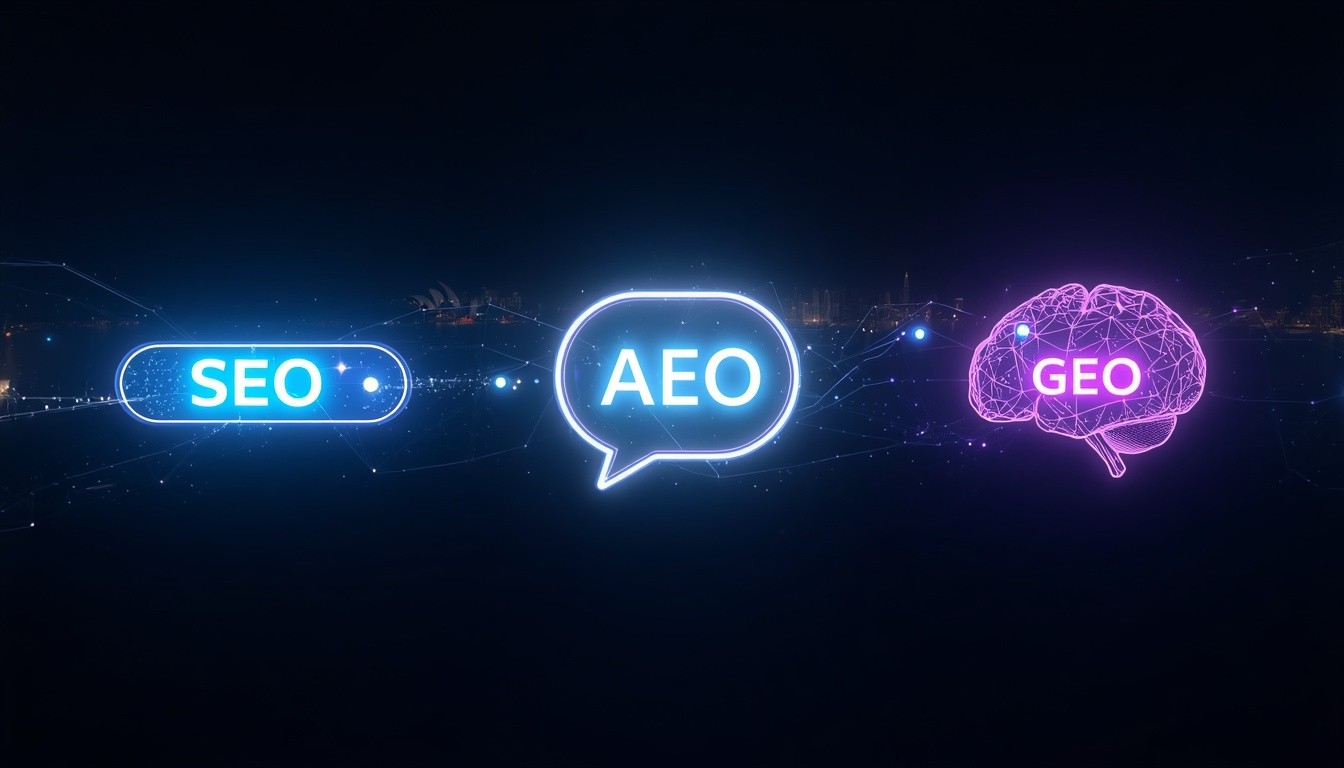
So where does that leave your business? Here is the short version. SEO vs AEO vs GEO is not a three-way fight. It is three layers of the same job. SEO gets your pages found and ranked. Answer Engine Optimisation (AEO) gets your content chosen as the direct answer. Generative Engine Optimisation (GEO) gets your brand mentioned inside responses written by tools like ChatGPT and Gemini.
This guide explains SEO vs AEO vs GEO in plain terms. It covers Google SGE and where it ended up, how AEO vs GEO differ in practice, and what AI search optimization Australia businesses should do first. We have also tried to be straight about what is proven and what is still guesswork, because a lot of the advice floating around right now is the second kind dressed up as the first.
Why SEO vs AEO vs GEO matters to Australian businesses right now
The numbers moved quickly. Roy Morgan’s March 2026 research found that 13.6 million Australians, or 58% of people aged 14 and over, used AI tools in an average four weeks. ChatGPT led with 10.5 million users (45%), and Gemini came second with 5 million (21%). Telsyte measured it differently and put the national AI user base past 17 million. The methods differ, but the direction does not.
Now the other side. YouGov research reported that more than 70% of Australians use AI in their search journey, yet only 16% say it is where they start. Conjointly’s March 2026 tracker found 71% of Australians use search engines about as much as they did a year earlier. And Statcounter figures reported by Optimising put AI chatbots at under 0.4% of Australian web traffic in May 2026, with traditional search still above 90%.
Read those together and the picture is clear. Search is not dying. It is splitting. Google is still the front door for most people, but what Google shows at that door has changed.
The Pew Research Center study of 900 US adults is the clearest evidence on what that does to clicks. When an AI summary appeared, users clicked a traditional result in 8% of visits. Without one, it was 15%. Only 1% of visits led to a click on a link inside the summary itself. Google disputed the study’s methodology, and it covers US users in March 2025, so treat it as a signal rather than a forecast for Australia. Still, it explains why ranking number three is worth less than it used to be, and why being the source the summary quotes is worth more.
SEO vs AEO vs GEO at a glance
| SEO | AEO | GEO | |
| Full name | Search Engine Optimisation | Answer Engine Optimisation | Generative Engine Optimisation |
| Main goal | Rank pages in search results | Be the answer that gets selected | Be named or recommended in AI-written responses |
| Where it shows up | Google and Bing results, local pack | Featured snippets, AI Overviews, voice assistants | ChatGPT, Gemini, Perplexity, Copilot, AI Mode |
| What wins | Relevance, authority, technical health | Clear, direct, well-structured answers | Clear brand identity, citations, trusted mentions across the web |
| Typical measure | Rankings, organic traffic, leads | Snippet and AI Overview presence, branded search | Brand mentions, referral traffic from AI tools |
The lines blur in real work. A page that ranks well, answers the question in its first two sentences and comes from a business the web clearly knows about tends to do well in all three.
SEO: the foundation that still carries the weight
SEO is the practice of making your site easy for search engines to crawl, understand and trust, then matching your content to what people are searching for. It covers technical health, content, links and local signals.
Why does it still matter if AI is taking over? Because AI search features do not work in a vacuum. In our experience, AI Overviews and AI Mode lean heavily on pages Google already indexes and rates well. If your site is slow, badly structured or thin on content, you are weak at the base of everything above it.
The core of good SEO for an Australian business looks like this:
- A fast, mobile-friendly site that search engines can crawl without hitting dead ends
- Pages built around a specific search intent, not a keyword stuffed into a generic service page
- A properly completed Google Business Profile and consistent name, address and phone details across directories
- Local pages that are genuinely different from each other, not one template with the city swapped out
- Links from reputable Australian sites in your industry
If you are weighing up SEO services for Australian businesses, ask any agency how they handle technical audits, content planning and reporting. Ours sit under our SEO services, and our SEO and marketing plans start at AUD 900 a month. A site that cannot load quickly will undercut all of it, which is why we pair SEO with bespoke website creation when the build itself is the problem.
Google SGE: what it was and what it became
You will still see people searching for Google SGE, so it is worth being precise. SGE stands for Search Generative Experience. Google announced it at I/O in May 2023 as a Search Labs experiment. At I/O 2024, Amsive’s I/O 2024 recap notes, the feature was rebranded as AI Overviews and began rolling out in the US on 14 May 2024.
The name SGE is gone. The behaviour is not. It now lives in two places:
- AI Overviews are the summaries at the top of many results pages.
- AI Mode is a conversational search experience for longer, multi-part questions. It reached Australia on 8 October 2025, according to Google’s own announcement. It uses what Google calls query fan-out, which splits one complex question into several smaller searches. SmartCompany’s launch coverage has a good plain-English explanation.
Google has since said AI Mode passed one billion monthly users, in Google’s latest Search update, and that people can now move from an AI Overview straight into an AI Mode follow-up.
What does that mean for your content? Early testers of AI Mode asked questions two to three times longer than traditional queries. So the pages that get pulled in tend to cover a topic’s sub-questions properly, not just the headline term. If someone asks about the best CRM for a small Brisbane clinic, the system quietly runs searches on pricing, privacy rules, integrations and local support. Your page needs to have something solid to say on those side questions.
Answer Engine Optimisation (AEO): becoming the answer
Answer Engine Optimisation is the practice of structuring content so that a search feature or assistant can lift a clear answer straight from your page. Think featured snippets, AI Overviews, voice assistants and the answer boxes inside AI tools.
The idea is simple. People ask questions. Systems want a short, accurate reply they can trust. If your page gives one, cleanly, you become a candidate.
What works in practice:
- Put the answer first. Under a question-style heading, give a direct reply in the first sentence or two, then expand. A common rule of thumb is 40 to 60 words for that opening block. It is a habit that works, not a Google rule.
- Use real questions as headings. Pull them from customer emails, sales calls and search suggestions rather than inventing them.
- Add structured data. Organization, LocalBusiness, Product, Article and FAQ schema help machines read what a page is about. Schema does not guarantee a feature. It removes ambiguity.
- Keep facts consistent. Opening hours, service areas, prices and names should match everywhere they appear.
- Write for the ear. Voice answers favour short, natural phrasing.
We build schema into sites from the start, which is far easier than retrofitting it onto a finished build. It is a big part of how we approach AEO across our marketing services.
Generative Engine Optimisation (GEO): getting named in the response
Generative Engine Optimisation is aimed at a different outcome. When someone asks ChatGPT, Gemini or Perplexity for a recommendation, the tool writes a response from many sources. GEO is the work of making your brand one of the things it mentions or cites.
This is harder to control, and anyone promising guaranteed AI citations is overselling. What we can say is which signals seem to matter:
- A clear, consistent brand identity. The same description of who you are, what you do and where, repeated across your site, profiles and directories.
- Mentions on sources that models read. Pew’s data shows Pew’s source breakdown is worth a look here: Wikipedia, Reddit and YouTube together made up about 15% of sources in the AI summaries it examined, and government sites another 6%. Reputable third-party coverage counts for more than your own claims.
- Original information worth quoting. Your own data, pricing explanations, process detail and expert commentary give a model something it cannot get elsewhere.
- Crawlable pages. If you block AI crawlers in robots.txt without meaning to, you have opted out. Check it.
- Platform differences. ChatGPT, Gemini and Perplexity draw on different mixes of sources, so one tactic rarely covers all of them.
For businesses that want to be present when customers ask an assistant directly, our AI and machine learning work and chatbot builds sit alongside the GEO side of search, since the same structured knowledge about your business can power both.
AEO vs GEO: the practical difference
People mix these up constantly, so here is how we separate AEO vs GEO when planning work.
AEO is about selection. A system has a question and picks one answer from a page. The reward is often visibility at the top of the page, and sometimes a click. GEO is about inclusion. A system writes its own answer from many places, and the reward is a mention, a recommendation or a citation, which may or may not send traffic.
A local plumber in Adelaide shows the split. AEO work makes the page on emergency call-out costs answer that question in two lines, with schema behind it. GEO work makes sure that when someone asks an assistant who to call, the plumber’s name appears in the response because reviews, directories and local coverage all say the same thing about them.
Most of the work overlaps. Clear structure, consistent facts and trustworthy content help both. If you have to sequence them, do SEO fixes first, AEO second and GEO as an ongoing layer.
E-E-A-T: the thread running through all three
E-E-A-T stands for Experience, Expertise, Authoritativeness and Trust. It comes from Google’s quality rater guidelines. Strictly speaking it is not a single ranking factor. It is a framework for judging whether content deserves to be believed, and Google’s people-first content guidance builds on the same questions: who created this, how, and why.
Trust sits at the centre. The other three feed it. And it matters just as much for AI answers, because a system that quotes you is putting its own credibility behind yours.
Google has also been clear that how content is made matters less than whether it is original, useful and reliable. Low-effort, unoriginal pages are the problem, whether a person or a tool wrote them.
Here is how to show each element on your own pages:
- Experience: Describe work you have actually done. Include real photos, real process detail and specifics only someone who did the job would know.
- Expertise: Put a named author on the page with their role and background, and link to a proper bio.
- Authoritativeness: Earn mentions and links from industry bodies, local press and respected publications. Cite your own sources too.
- Trust: Show your business name and ABN, a real address, clear contact options, honest pricing and a visible update date. Fix errors when you find them.
Our own team has a combined 65+ Australian projects and 500+ deployments behind it, and we say so on our about page for exactly this reason. Claims like that only help when a reader can check them.
What Australian businesses should do first
If you are not sure where to begin, this order works for most small and mid-sized businesses.
- Audit your technical SEO. Fix speed, crawl errors, mobile problems and broken internal links before anything else.
- Pick your ten most valuable pages. Usually your main service pages and your best-performing articles. Rewrite each so the answer comes first and the sub-questions are covered.
- Add structured data. Start with Organization or LocalBusiness, then Article, Product or Service where they fit.
- Tighten your entity. Make sure your business name, description, location and services read the same on your site, Google Business Profile, LinkedIn and key directories.
- Show real authorship. Add named authors, bios, sources and update dates to your content.
- Build local depth. If you serve more than one city, create genuinely useful pages for each, such as Melbourne or Brisbane, not clones.
- Measure what you can. Track referral traffic from AI tools in GA4, watch branded search, and check how often your brand appears when you ask the assistants your customers’ questions. Our analytics and insights work covers the setup.
- Review quarterly. This area moves fast. What worked six months ago may not hold.
Online stores have extra work to do. Product data, reviews and feeds feed directly into AI shopping answers, so our Shopify and ecommerce builds treat that data as part of the site, not an afterthought.
How Smart Servix can help
We are a Sydney web development and digital agency, and we handle SEO, AEO and GEO as one connected job rather than three separate retainers. That usually starts with a technical and content audit, moves into rebuilding priority pages, and then settles into monthly reporting. If you would like to see where your site stands, you can book a strategy call and we will walk through it with you.
For more on where search is heading, keep an eye on our blog.
Frequently asked questions
What is the difference between SEO vs AEO vs GEO?
SEO ranks your pages in search results. AEO structures your content so it can be chosen as the direct answer in snippets, AI Overviews and voice results. GEO builds your brand’s presence in AI-written responses from tools like ChatGPT and Gemini. SEO vs AEO vs GEO is best seen as layers that build on one another, with SEO at the base.
Is Google SGE still a thing?
Not under that name. Google announced SGE in 2023 as a Labs experiment and moved it into general rollout as AI Overviews in 2024. A more conversational version, AI Mode, reached Australia in October 2025. If you optimise for AI Overviews and AI Mode, you have covered what people used to mean by Google SGE.
What is Answer Engine Optimisation?
Answer Engine Optimisation is the practice of writing and structuring content so that search features and assistants can pull a clear, accurate answer directly from your page. It relies on direct answers under question headings, structured data and consistent facts.
What is Generative Engine Optimisation?
Generative Engine Optimisation aims to get your brand mentioned or cited when AI tools write their own responses. It relies on a clear brand identity, trusted third-party mentions, original information and pages that AI crawlers can access.
AEO vs GEO: which should I focus on first?
Fix your SEO foundations first, then start with AEO because it is more measurable and overlaps with good content practice anyway. GEO is worth building alongside, but results are harder to track and cannot be guaranteed.
Does AI search optimization Australia need a different approach from the US?
Somewhat. Google still dominates Australian search, and AI Mode only reached Australia in late 2025, so features and ads arrive here later than in the US. Local signals matter more too, including Australian English, .com.au domains, local directories and city-specific pages. The Pew click data is American, so check your own analytics before assuming the same drop.
Do I still need SEO services for Australian businesses if AI is taking over?
Yes. Search is still the biggest source of web traffic in Australia, and AI features rely on well-ranked, well-structured pages. SEO services for Australian businesses now work best when they include answer-focused content and structured data from the start.
How do I know if my brand appears in AI answers?
Ask the major assistants the questions your customers ask, using a few different phrasings, and note whether you appear. Track referral traffic from AI tools in your analytics and watch branded search volume. No tool gives a perfect picture yet, so treat the results as directional.
Does AI-written content hurt my rankings?
Google’s position is that the method of production is not the test. Originality, usefulness and reliability are. Content with no real experience or checking behind it is the risk, regardless of who or what wrote it.
SEO vs AEO vs GEO will keep shifting, but the base stays the same: be useful, be clear and be easy to trust. If you want help working out where to put effort first, talk to our team.