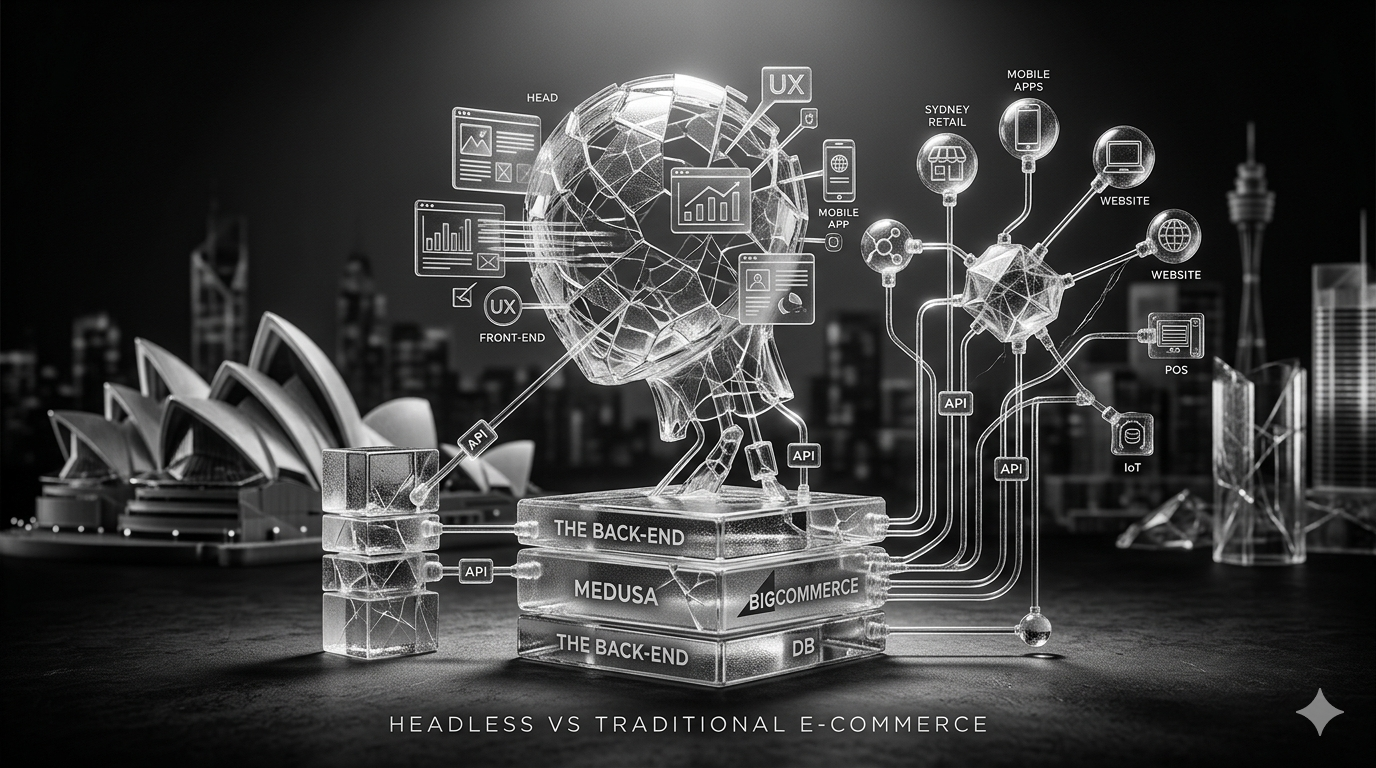
In the current digital era, the foundational architecture of an online presence determines the ultimate ceiling of a brand’s growth. At Smart Servix, we have observed a significant paradigm shift within the Australian retail sector as businesses move away from rigid, all-in-one platforms toward more flexible, decoupled environments. It is imperative to understand that the choice between “Mainstream” and “Headless” is no longer merely a technical preference but a strategic business decision that impacts long-term scalability and market agility.
Defining the Paradigm: Monolithic vs. Decoupled Systems
To grasp the future of digital trade, one must first differentiate between monolithic and decoupled (headless) systems. From a strategic perspective, a traditional or “mainstream” e-commerce platform—such as a standard Shopify or WooCommerce installation—is considered monolithic. In this model, the “head” (the front-end user interface) and the “body” (the back-end database and logic) are inextricably linked. While this offers simplicity, it often results in a “one-size-fits-all” constraint that can stifle unique brand experiences.
Conversely, a headless architecture involves a decoupled approach where the front-end is entirely separated from the back-end functionality. Communication occurs via high-performance APIs. This allows we at Smart Servix to deploy cutting-edge front-end frameworks while utilizing robust back-end engines. This separation ensures that changes to the user interface do not interfere with the underlying business logic, providing a level of stability and flexibility that monolithic systems cannot replicate.
The Headless Advantage: A Comparative Analysis
When evaluating Headless E-commerce vs Mainstream E-commerce, businesses must weigh several critical performance metrics. Below, we provide a side-by-side comparison to assist in your architectural evaluation.
| Feature | Mainstream (Monolithic) | Headless (Decoupled) |
| Speed | Limited by platform bloat and plugins. | Lightning-fast; optimized for Core Web Vitals. |
| Creative Control | Constrained by theme templates. | Infinite; total freedom in UX/UI design. |
| Multi-channel | Primarily focused on the web browser. | Native support for POS, App, and IoT. |
| Development Cost | Lower initial setup; higher long-term debt. | Higher initial investment; lower scaling costs |
Why Headless is the King of SEO
From an organic search perspective, composable commerce in Australia is rapidly becoming the gold standard. We recognize that search engines increasingly prioritize user experience metrics. Headless architecture provides an unparalleled advantage in this domain. Because the front end is built independently, we can eliminate the “code bloat” typically found in mainstream themes, leading to near-instantaneous load times—a primary ranking factor in the Sydney digital transformation landscape.
Furthermore, headless systems offer granular control over metadata and schema markup. Unlike traditional platforms that may auto-generate suboptimal URL structures or limit custom tags, a decoupled approach allows for precision-engineered SEO strategies. This level of custom metadata control ensures that every product page is perfectly optimized for the specific nuances of the Australian market, allowing brands to dominate highly competitive search results with surgical accuracy.
Local Market Insight: Scaling for Australian Retail Peaks
Australian retail is characterized by intense, localized demand spikes, most notably during Black Friday, Cyber Monday, and the End of Financial Year (EOFY) sales. For Sydney-based businesses, e-commerce scalability is not a luxury—it is a survival requirement. Traditional monolithic systems often struggle under heavy traffic, leading to increased latency or catastrophic site failures during peak conversion windows when the server must process both the front-end rendering and back-end logic simultaneously.
By implementing a headless strategy, we enable businesses to distribute the computing load effectively. Since the front end is often hosted on a Content Delivery Network (CDN), the “head” of your store remains responsive regardless of how hard the back-end database is working. This decoupling ensures that even during the highest-traffic EOFY events, the customer journey remains seamless, protecting your brand reputation and maximizing revenue capture during the most critical periods of the fiscal year.
Is Your Business Ready for Headless?
Transitioning to a decoupled architecture offers immense benefits, but it requires a specific level of organizational readiness. Use the following checklist to determine if your enterprise is prepared for the shift:
- Technical Maturity: Do you have access to a specialized development team to manage an API-driven environment?
- Omnichannel Goals: Does your strategy involve selling across multiple platforms, such as mobile apps or advanced POS systems?
- Performance Requirements: Is your current conversion rate being hampered by slow page loads or rigid mobile experiences?
- Customization Needs: Does your brand require a unique user interface that cannot be achieved through standard marketplace themes?
- Budgetary Alignment: Are you prepared to invest in a superior long-term infrastructure rather than a quick, low-cost template?
Strategic Conclusion
The architectural shift toward headless e-commerce represents the next evolution of digital trade in the Australian market. While mainstream platforms serve as an entry point, the demands of modern SEO and scalability often require a more sophisticated, composable approach. We believe that for businesses aiming to lead in their respective sectors, the transition to a decoupled system is a matter of “when,” not “if.”
Are you ready to elevate your digital infrastructure? We invite you to explore our e-commerce solutions and request a Technical Architecture Audit from the Smart Servix team today.